



Why Is Injection Moulding a Good Manufacturing Process?
Injection moulding is a good, efficient manufacturing process because it can produce complex plastic components quickly, consistently and at scale. Once the mould tool and production settings are proven, each cycle can create plastic parts with controlled dimensions, surface finish and material performance. It is especially effective when production volume is high enough to spread the initial tooling investment across many components.
What makes injection moulding an effective production process?
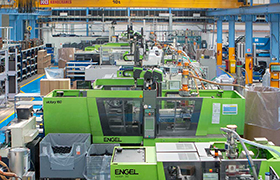
The process combines repeatability, design freedom and production efficiency. Molten thermoplastic polymer is injected into a precisely manufactured cavity, held under controlled pressure until cooled and its final form ejected from the mould. This process then repeats that cycle with limited variation. Rutland Plastics can support this complete end-to-end process through its design for manufacture support and plastic injection moulding services capabilities.
- Repeatable production for consistent component quality
- Complex shapes, ribs, bosses, clips and fixing features in one part
- A wide choice of polymers, colours, additives and reinforced grades
- Short production cycles once the process is validated
- Potential to consolidate several parts into one moulded component
Does injection moulding produce consistent parts?
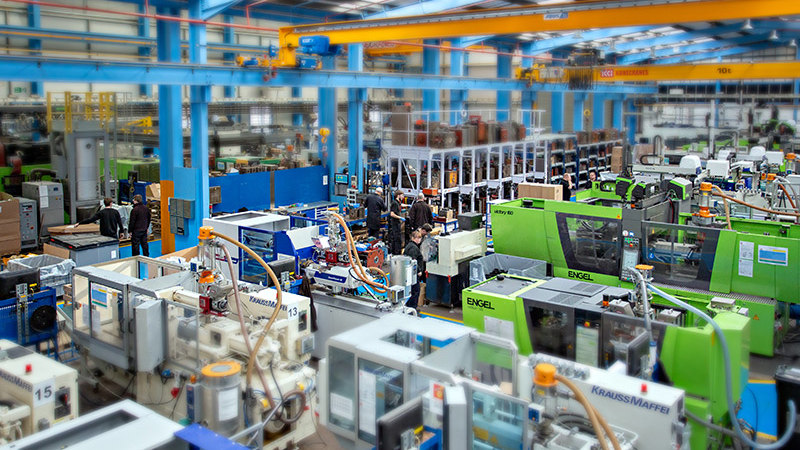
Yes. A high-quality mould tool, suitable material and controlled process allow thousands of parts to be produced to agreed requirements. Consistency depends on more than the machine: gate position, cooling, venting, shrinkage, material preparation and quality checks all matter. Rutland Plastics agrees all the relevant requirements at the start and applies appropriate quality standards and controls throughout production.
Can it manufacture complex component designs?
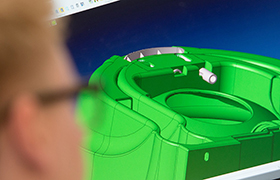
Injection moulding can form detailed geometry that would be slow or expensive to machine repeatedly. Draft angles, wall thickness, radii and undercuts still need careful consideration. Early injection moulding design guidelines help prevent sink marks, warpage, weak knit lines or difficult ejection. Where uncertainty remains, 3D printing and prototyping can validate fit and function before tooling is commissioned.
When is injection moulding most cost-effective?
This manufacturing process is ideal for repeat or volume production. Tooling creates an upfront cost, but the unit cost can fall substantially as output rises. The best commercial result comes from matching cavity count, cycle time, machine size, material and expected lifetime volume instead of specifying the cheapest tool in isolation.
What are the limitations?
Injection moulding is not automatically the best choice for every project. Very low volumes, designs that change frequently or components with unsuitable geometry may favour 3D printing, machining or another process. Tool lead time and design commitment also need to be considered. A manufacturability review should therefore come before a tooling decision.
Why work with Rutland Plastics?
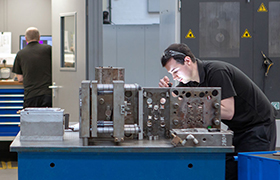
Rutland Plastics combines in-house design for manufacturing advice, prototyping, in-house injection mould tool making and maintenance services, moulding and finishing within one UK-based manufacturing relationship. This gives customers a clearer route from initial concept to repeat production, including technical support for small precision parts, large mouldings and demanding assemblies. Take a look at relevant injection moulding case studies or speak to the Rutland Plastics team.
FAQs – Mould Tool Design and Product Quality
It can be, particularly where part performance or repeatability justifies tooling, but prototyping or low-volume tooling should be assessed against the required quantity and product life.
Once the tool and process are validated, short repeatable cycles and automation can deliver a low unit cost across higher production volumes.
Yes. Features such as clips, ribs, bosses, threads, inserts and branding can sometimes be integrated into one moulded component, reducing separate parts and assembly stages.
No. Tool quality is essential, but material selection, component design, machine choice, processing conditions and quality control also determine the result.
