



Is Injection Moulding Expensive?
Injection moulding can be expensive at the beginning because a precision mould tool must be designed, manufactured and tested. However, it can become highly cost-effective for repeat production because the tooling cost is spread across every component and automated cycles reduce the cost per part. The meaningful comparison is total lifetime cost, not tooling price alone.
What are the costs involved?
A quotation may include design support, prototypes, mould-flow analysis, the mould tool manufacture, trials, material testing, machine time, quality checks, finishing, assembly, packaging and logistics. Each project will have its own specific requirements, which will have an impact on price and may include:
- Part complexity and size
- Tool material, construction and number of cavities
- Annual and lifetime production volume
- Polymer grade, additives, colour and drying needs
- Machine size, cycle time and energy use
- Inspection, validation and documentation requirements
- Secondary operations and packaging
Why does the mould tool cost so much?
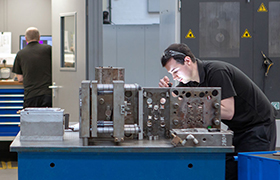
The mould tool is a precision production asset. It may contain cavities and cores, cooling circuits, feed systems, vents, ejectors, slides, sensors and replaceable inserts. It must withstand repeated pressure and temperature cycles while producing the agreed geometry. Rutland Plastics’ in-house injection mould tool services covers specification, manufacture, maintenance and refurbishment.
How does production volume change unit cost?
If a £30,000 tool makes 10,000 components, tooling alone represents £3 per part before moulding costs. Across 300,000 parts, the same simple allocation becomes £0.10 per part. This illustration excludes finance, maintenance, scrap and tool life, but it shows why reliable volume forecasts matter. Multi-cavity tooling can further increase output, although it requires greater initial investment.
How does component design affect price?
Thick sections can extend cooling time; undercuts can require slides or lifters; tight tolerances can increase toolmaking and inspection effort; and unnecessary size can require a larger machine. A design for manufacture support review can simplify geometry, reduce mass, improve cycle time and avoid late changes. 3D printing and prototyping may also identify functional issues before production tooling.
Can a cheaper tool cost more over time?
Yes. A low initial quote may exclude expected maintenance (Rutland Plastics includes maintenance), suitable steel, balanced cooling, spare inserts, trials or tool modifications. If the tool produces slow cycles, high scrap or frequent downtime, total lifetime cost can exceed a more robust option. Tool specification should reflect lifetime demand and critical quality needs.
How can injection moulding costs be reduced?
Ensure that the requirements are finalised before tool manufacture, use consistent walls, avoid unnecessary actions, choose the correct material, size the tool for realistic demand and combine operations only where technically sound. Stable production and planned maintenance usually create more durable savings than simply negotiating the lowest hourly machine rate.
When is another process cheaper?
For prototypes, very small batches or frequently changing designs, machining or additive manufacturing may avoid tooling investment. As demand grows, the repeatability and cycle efficiency of plastic injection moulding can become more economical. Rutland Plastics can compare options through project management process; speak to the Rutland Plastics team with CAD data and expected volumes for an informed review.

FAQs
For a new product it is often the mould tool, although large parts, specialist polymers, long cycles or extensive finishing can make production costs as significant a consideration.
It can reduce unit cost by producing several parts per cycle, but it costs more to build and must be justified by demand and process stability.
Often yes, subject to inspection, compatibility with available machines, ownership, condition, documentation and any refurbishment required.
Provide 3D CAD data, drawings, material requirements, tolerances, appearance expectations, annual and lifetime volumes, quality requirements and any assembly or packaging needs.
