



What Are the Advantages of Plastic Injection Moulding?
A practical guide to why manufacturers choose injection moulding for repeatable, scalable and high-quality plastic component production.
The main advantages of plastic injection moulding are repeatability, precision, speed, scalability, design flexibility, material choice and lower cost per part at volume. It is especially useful when the same plastic component needs to be produced reliably many times.
Introduction
A practical guide to why manufacturers choose injection moulding for repeatable, scalable and high-quality plastic component production.
Reliable repeat production
Once a mould tool is designed, tested and approved, injection moulding can produce consistent parts again and again. This repeatability is one of the biggest reasons manufacturers choose the process. It allows product teams to plan production, manage stock and maintain quality across batches.
Lower cost per part at volume
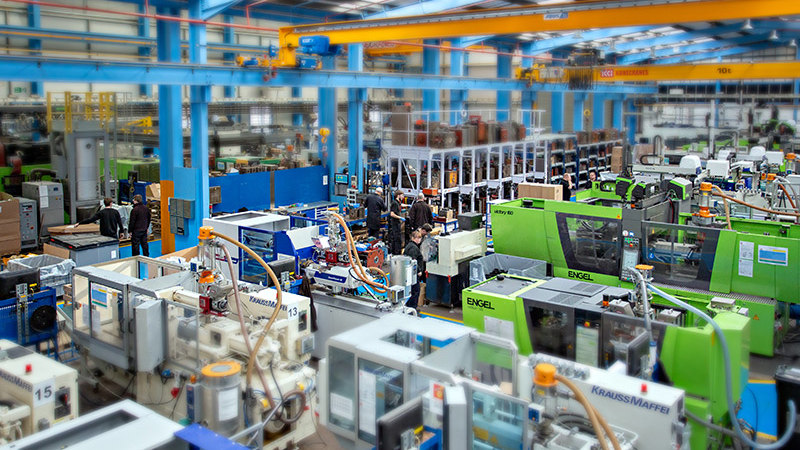
Injection moulding involves an upfront tooling investment, but the cost per part can become very competitive as volume increases. The mould tool can produce repeated cycles efficiently, reducing unit cost compared with many alternative processes for medium and high-volume production.
Design and material flexibility
Injection moulding supports a wide range of part shapes, materials, colours, finishes and performance requirements. Components can include clips, ribs, bosses, inserts, branding features and assembly functions. Material options can support strength, flexibility, chemical resistance, heat performance, transparency or durability depending on the end use.
Strong quality control
Injection moulded parts can be manufactured with defined process controls and inspection methods. Rutland Plastics supports quality through ISO-certified systems, ERP traceability, calibrated measuring equipment and experienced technical teams. This is important for sectors where consistency, documentation and repeatability matter.
A complete manufacturing route
Plastic parts often need more than moulding. Rutland Plastics can support design, prototyping, mould tools, moulding, machining, finishing, sonic welding, assembly, warehousing and logistics. This joined-up approach can reduce supplier complexity and improve accountability across the project.
Find out whether injection moulding is right for your product
Rutland Plastics can review your design, material requirements and production volumes to help you choose the right manufacturing route.
FAQs – Advantages of Injection Moulding
Its biggest advantage is repeatable production of consistent plastic parts at scale.
For prototypes and one-offs, 3D printing may be cheaper. For repeat production, injection moulding is usually more cost-effective.
Yes. Strength depends on design, material choice, wall thickness, ribs, load requirements and processing conditions.
Yes. Complex parts can be made, but design for manufacture is important to avoid tooling and production issues.
Yes. Rutland Plastics offers additional services including machining, finishing, sonic welding and assembly.
