



What Types of Parts Can Be Made With Injection Moulding?
A practical guide to the shapes, sizes and applications that can be produced through plastic injection moulding.
Injection moulding can make small clips, housings, covers, connectors, enclosures, pipe fittings, medical components, industrial parts, automotive components and large technical mouldings. The suitability depends on part design, material, size, tolerances and production volume.
Introduction
A practical guide to the shapes, sizes and applications that can be produced through plastic injection moulding.
Small technical parts
Injection moulding can produce small clips, connectors, caps, buttons, housings and precision components. These parts often rely on accurate tool design, stable processing and material choice to maintain repeatability.
Functional housings and covers
Many products use moulded housings, enclosures, protective covers and casings. These can include ribs, bosses, mounting points, branding and assembly features when designed correctly for moulding.
Large and heavy components
Rutland Plastics can produce large mouldings up to 48kg and 1.5m, including thick-section mouldings. Large parts need careful material flow, cooling, handling and tooling design to avoid defects.
Parts for assemblies
Injection moulded parts often form part of larger assemblies. Secondary operations such as sonic welding, machining, gluing, finishing and assembly can help deliver a more complete component or sub-assembly.
How to assess suitability
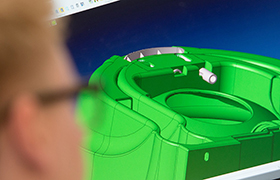
A part is more likely to suit injection moulding when it has repeat demand, a stable design, suitable material requirements and a business case that justifies tooling. Rutland Plastics can review drawings or CAD files to advise on suitability.
Find out whether your component can be moulded
Send Rutland Plastics your drawings, CAD data or sample part for a manufacturability review.
FAQs – Parts Made With Injection Moulding
Yes. Rutland Plastics can mould parts from 1g.
Yes. Rutland Plastics can mould parts up to 48kg and 1.5m.
Yes. Insert and outsert moulding may be suitable for some applications.
Yes. Machining, finishing, sonic welding and assembly can be used where required.
A design for manufacture review can assess material, geometry, tooling and volume suitability.
