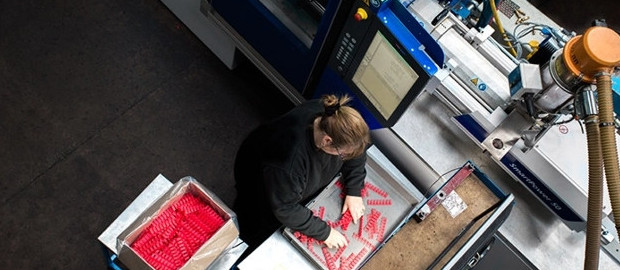
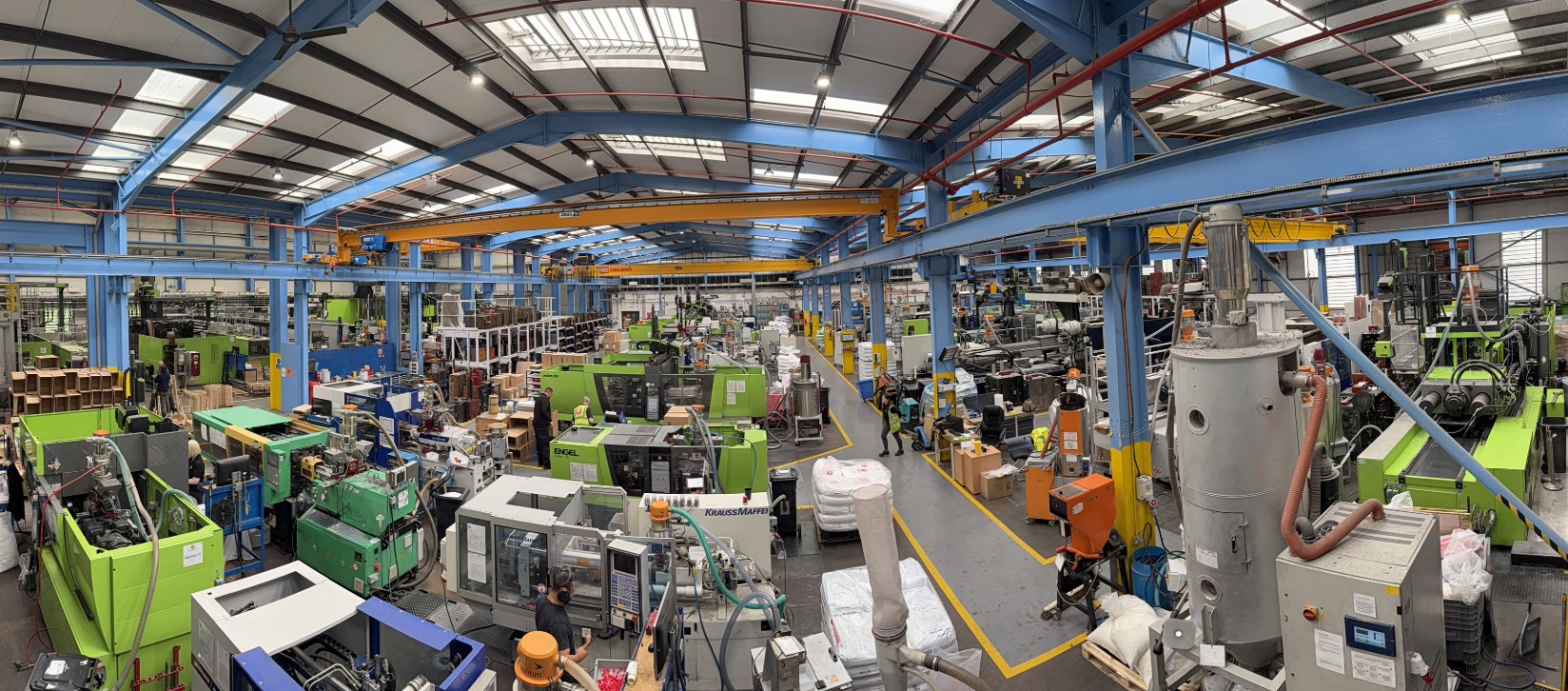
A panorama of the factory floor, showing the 30+ injection moulding machines at Rutland’s site in Oakham.
As part of the latest PlastikCity on Tour visit, Will and Jess Clarke visited Rutland Plastics in Oakham, Rutland, and met Caroline and Stuart Johnston to learn more about the company’s injection moulding capabilities, technical expertise and continued investment during its 70th anniversary year.
Founded in 1956, Rutland Plastics has grown from a small moulding business into one of the UK’s most established privately owned custom injection moulders. The company remains rooted in Oakham, Rutland, where expansion has continued over many decades, with the factory now covering more than 6,100 square metres.
Today, Rutland Plastics employs more than 150 people and operates 31 injection moulding machines, ranging from 50 tonnes up to the newly installed 2400-tonne machine. This latest investment marks a significant addition to the company’s large-part moulding capability and forms part of a broader long-term approach to reinvestment, efficiency and technical development.
The visit gave us a closer look at a business that combines long-standing manufacturing heritage with modern moulding capacity, in-house technical support, automation, toolroom services, secondary operations and a practical approach to sustainability.
A 70-Year Manufacturing Story
Rutland Plastics’ story began in 1956, when Don Ansell (Grandfather of current Director, Caroline Johnston and MD, Steve Ayre) and Ron Smart founded the company after developing their toolmaking skills in the East Midlands post-war. In its early years, the company manufactured its own plastic products, including artificial flowers and children’s toys, with one of its first major contracts involving moulding plastic roses for Cadbury chocolate boxes.
As markets changed, Rutland Plastics diversified into custom injection moulding for other companies. Over time, the business developed into a broad-based trade moulder, supporting customers across sectors including medical, consumer products, utilities and industrial applications.
A major British Gas contract in the 1970s helped shape one of its most distinctive areas of technical expertise: electrofusion fittings for joining plastic pipes. That long-term technical development remains part of the company today. Rutland Plastics still manufactures on a trade basis across a wide range of sectors, while continuing to invest in its Oakham site, its people and its production capability.
The company operates 24/7 production and supports customers with components ranging from small precision parts through to large injection mouldings weighing up to 48kg and measuring up to 1.7m. Its capabilities include large-part moulding, thick-section moulding, gas-assisted injection moulding, medical moulding, insert and outsert moulding, and the processing of a wide range of polymers, reprocessed materials, filled materials, additives and masterbatches.
A Major Investment in Large-Part Moulding
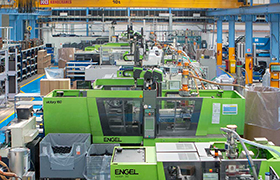
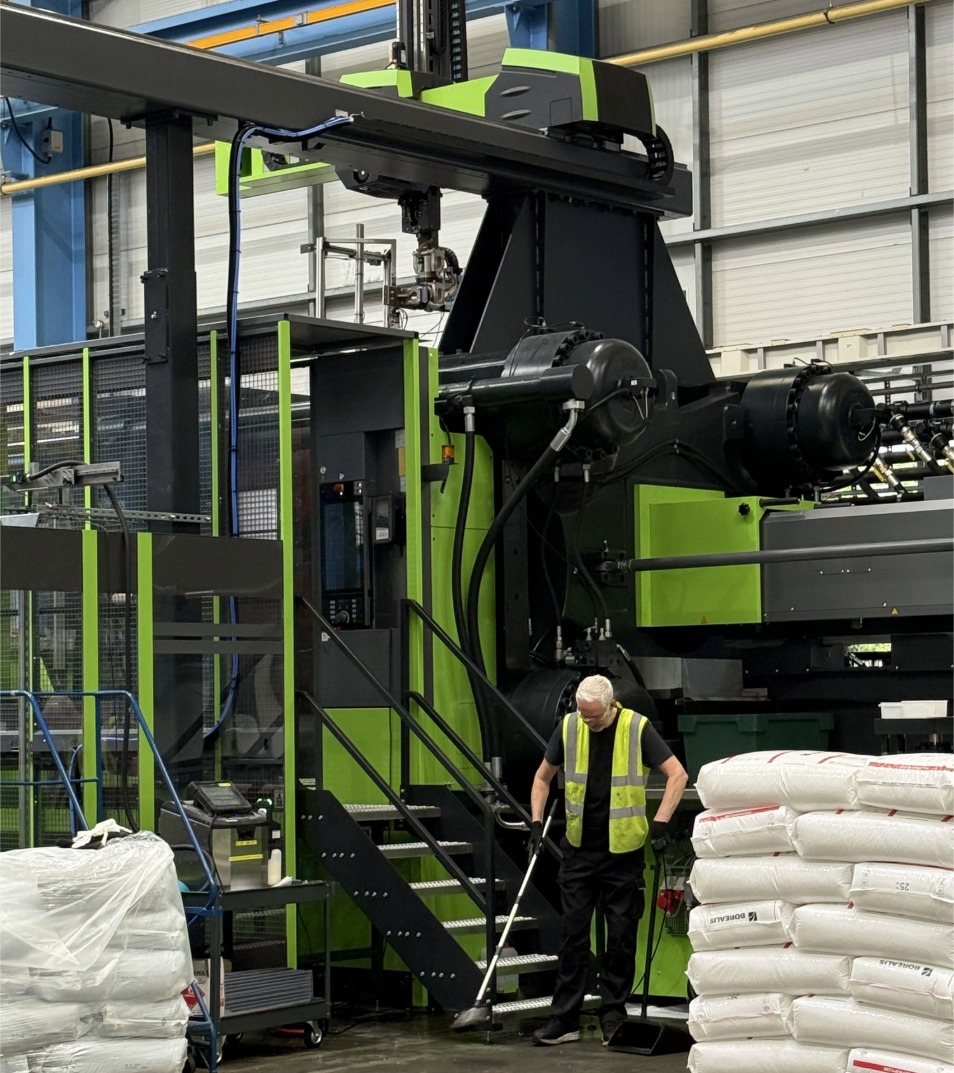
One of the most significant recent developments at Rutland Plastics is the arrival of its new 2400-tonne ENGEL injection moulding machine, installed during the company’s 70th anniversary year.
The machine extends Rutland Plastics’ already substantial moulding range and strengthens its ability to support customers with larger and more technically demanding components. During the visit, the scale of the new machine highlighted the company’s continued confidence in UK manufacturing and its commitment to investing in capacity where it adds value for customers.
Rutland Plastics has built its business around balance, flexibility and long-term stability. Its customer base spans medical, consumer, utilities and other industrial sectors, helping the business remain resilient when individual markets fluctuate.
As Stuart Johnston, Director at Rutland Plastics, explained during the visit, the company’s strategy is built around steady, organic growth.
“We try not to focus too heavily on one particular area,” said Stuart. “Having that mix helps in terms of stability. Everything here is long-term. We’re thinking about how we can grow steadily and organically without risking what everyone has worked hard to build over decades.”
Electrofusion Expertise
One of the most distinctive technical stories from Rutland Plastics is its involvement in electrofusion, a method of joining plastic pipes using fittings with built-in electric heating elements.
The company’s experience in this area dates back to work connected with British Gas and the move from traditional metal pipework to polyethylene pipe systems in the 1970s. Rutland Plastics was involved in developing methods for joining plastic pipes, with its expertise eventually leading to patented processes around the manufacture of electrofusion components, and co-developing the electrofusion process with its customer at the time.
Today, this remains an important area of knowledge within the business. The company’s electrofusion work is widely used in sectors such as utilities, drainage, sewage, petrochemical, water and gas applications.
For our visit, this provided a useful example of how the company’s long-term manufacturing experience has translated into specialist knowledge that still supports customers today, with modern variations of these initial electrofusion products still being produced over 50 years later.
Tooling, Quality and Additional Services
Alongside injection moulding, Rutland Plastics offers a wide range of supporting services designed to help customers manage projects through one manufacturing partner.
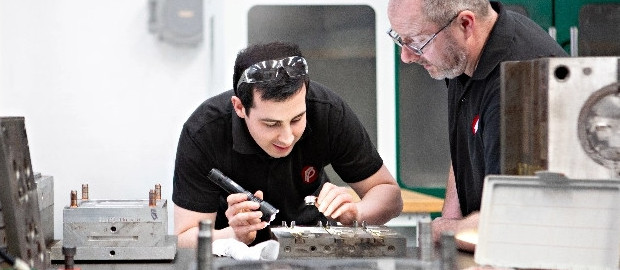
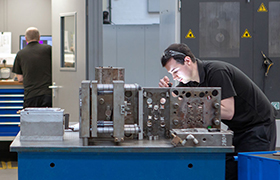
The visit included a look at the company’s in-house toolroom, which supports tooling modifications, maintenance and refurbishment. Rutland Plastics can also specify and manufacture tooling in-house or through selected partners, including overseas tooling where appropriate for larger tools or suites of moulds.
The company carries out routine tool maintenance free of charge for injection mould tools manufactured by Rutland Plastics or its partners, while Rutland Plastics remains the appointed moulder.
Quality control is another important part of the operation. During the visit, we saw the well-equipped quality lab, including coordinate measuring machines, light booths and materials testing equipment, supporting the company’s in-house quality assurance processes.
Rutland Plastics holds ISO 9001:2015 for quality management, ISO 13485:2016 for medical devices and ISO 14001:2015 for environmental management. The company also has Investors in People accreditation, reflecting its long-standing focus on staff development.
Additional services include machining, gluing, sonic welding, heat staking, assembly, warehousing and hot foil printing. These services allow Rutland Plastics to support customers beyond moulding alone, supplying sub-assemblies, complete products and packaged components ready for onward distribution.
In-House Automation and Skills Development
Another area that stood out during the visit was Rutland Plastics’ in-house automation capability.
Rather than relying solely on external turnkey automation providers, the company has invested in building skills internally. Rutland has a dedicated automation team that has grown over recent years and includes an experienced automation manager with Formula 1 experience, supported by a team of graduate mechanical engineers.
For Rutland Plastics, this approach reflects a wider philosophy of developing capability from within. The company regularly supports apprentices, graduate placements and internal progression.
“Our people are so important to us,” says Caroline Johnston. “It’s rare these days for people to stay with the same employer, but we’re proud to say we’ve got 13 employees who have been with us for over 25 years. Our longest serving employee recently celebrated 40 years at the company, and we have some fourth-generation people here as well.”
Rutland Plastics has close ties with local colleges and universities, and the business has worked with placement students from Loughborough University for around 20 years, with many returning to the company after completing their degrees.
Supporting the Wider Industry
Rutland Plastics continues to support industry events, including Interplas and Southern Manufacturing. The company sees trade events as valuable opportunities to support the industry, meet suppliers and customers, and remain visible within the wider manufacturing sector.
As a business that works across many sectors, Rutland Plastics also values events that attract a broad engineering and manufacturing audience. Alongside exhibitions, the company also supports local engagement, including school visits and tours for groups such as A-level design and technology students. These visits help younger people see modern manufacturing first-hand and understand the career opportunities available within the plastics industry.
Q&A with Stuart Johnston and Caroline Johnston
Following the tour, we sat down with Stuart and Caroline Johnston to discuss Rutland Plastics’ history, capabilities, investment and approach to long-term manufacturing partnerships.
Rutland Plastics is celebrating 70 years in 2026. What has helped the company remain successful for so long?
Stuart Johnston:
A lot of it comes down to long-term thinking. As a business, we try not to focus too heavily on one particular area. That helps when there is instability because one sector or product type might be up while another is down.
It means that when one market is booming, we might not see the same huge uplift as a company focused only on that area, but we are very stable. We are steady and consistent, and everything here is based around that long-term vision.
Caroline Johnston:
It also helps that we are privately owned. We do not have outside shareholders demanding short-term returns or pushing us into markets just because they look attractive at a particular moment.
That gives us the freedom to make decisions that are right for the business, our customers and our people over the longer term.
How would you describe Rutland Plastics’ ideal customer or project?
Stuart:
Our ideal customer is someone who has a product in mind, knows that there is a market for it and expects to need around 2,000-plus units, but has not yet committed to a tool.
At that point, we can take the project on, work through design for manufacture, help with material selection and bring it through to production properly from the beginning.
Caroline:
What is more difficult is when someone comes to us and says they have a great idea and already have a tool. At that stage, a lot of the important decisions may already have been made, and it can be harder to influence the outcome.
Ideally, we’ll work with customers through the full lifecycle of the project, from the early design stage through to production.
Why is early involvement so important in injection moulding projects?
Stuart:
The earlier we start speaking to customers, the better. That is where our approach to efficiency and environmental performance really starts.
If we are involved early, we can help reduce the amount the customer is spending, reduce the amount of plastic being used, reduce the carbon footprint and improve the life of the product. It creates better value for the customer over the long term.
We are looking to be a good value supplier over the long term, not just a short-term, lowest-cost option.
Caroline:
The design for manufacture support we offer is extremely thorough. We work with a lot of companies and consultants, and they often comment on how detailed that process is.
It is about making sure the product, material and tool are properly considered before production starts.
Stuart: If you want to be successful, or even survive, as a UK manufacturer, you cannot afford to be inefficient.
For us, efficiency means doing the right work up front, managing the risks and making sure that when we go into production, we do it with minimal disruption, minimal scrap, fast cycle times and consistent quality.
It is also about reducing manual intervention wherever possible because that is where cost and inconsistency can come in.
The electrofusion process is a distinctive part of Rutland Plastics’ history. How did that area of expertise develop?
Stuart:
Rutland Plastics was founded by Caroline’s grandad, and following a chance encounter with a British Gas executive, the company became involved in work around joining plastic pipes. Water and gas mains were moving from metal to polyethylene, but there needed to be reliable ways to join those pipes.
That led to work on electrofusion. Other companies were involved too, and some developed their own product ranges, but Rutland Plastics continued to manufacture on a trade basis and developed patented processes around the way we do it.
We still do significant work in this sector today, 50 years on from those initial products, so I’d say we’re one of the leading manufacturers in terms of knowledge and experience for electrofusion products, with our own patented processes and tools for the sector.
The new 2400-tonne ENGEL moulding machine represents a significant investment. What does it add to your moulding capability?
Stuart:
It extends the top end of our moulding range and gives us more capacity for large moulded parts. We were already experienced in large-part moulding, but this gives us additional capability and flexibility.
The investment also came from looking carefully at the efficiency of our existing equipment. Through energy monitoring, we could see how much power older machinery was using, and that helped support the case for investing in newer technology. The new machine is exceptionally efficient and will save tens of thousands of pounds of electricity cost per year.
Caroline:
It also works well for customers who have a whole suite of products. We can produce very small components through to large mouldings, so they do not necessarily have to split the work between different manufacturers. With a machinery range now from 50 tonnes to 2400 tonnes, we have the capacity and flexibility to support any project.
Why has Rutland Plastics chosen to build automation capability in-house?
Stuart:
It’s unusual for a moulder. Typically a manufacturing company might employ a consultant to come in and deliver a turnkey automation solution on a project-by-project basis. We decided to grow the capability and skills in-house.
That means we understand our processes better and we can support them day to day. Ultimately this means more resilience and efficiency delivering for our customers, and less reliance on external contractors so we can keep building that knowledge within the business.
Caroline:
We have a very experienced automation manager and we have a team graduate mechanical engineers learning from him.
It has become a really valuable internal capability.
How important are apprenticeships, placements and internal progression to the business?
Caroline:
It is very important. We normally have around six apprentices at any one time, and we have supported Loughborough University product design placement students for around 20 years.
Many of those placement students have come back to work for us after finishing their degrees.
Stuart:
Skilled staff are difficult to find, so we are always looking for people who have something about them that we can develop.
That might mean moving our operators into material handling, setting, the toolroom, design, quality or another technical area. We also support people through college, HNDs and foundation degrees where appropriate. The aim is to retain good people and give them opportunities to grow within the business.
How are you approaching energy efficiency and sustainability in practical terms?
Stuart:
A few years ago, when electricity prices increased, we looked at whether to add more solar panels to the roof.
Caroline:
We installed 900 solar panels in 2013, which can generate approximately 20% of our electricity demand at their peak. In June 2022 we hit a milestone of generating one million Gigawatts of power from the installation.
Stuart:
Instead of adding more panels, we invested in energy monitoring through our ERP system.
That allowed us to monitor every machine, pump, airline and piece of equipment, and identify underperformance or leaks. We can also look at a particular job and understand which machine runs it most efficiently. The system can then schedule that job into the most efficient machine as the first option.
It is about chipping away at energy consumption and making better decisions based on data.
Caroline:
Even when equipment is idling, it can use a lot of energy, especially when you multiply that across 30-plus machines. The system helps us see that quickly and act on it.
Stuart: We have also invested in heat recovery. We spend money putting heat into tools and then taking heat out of them, so it makes sense to capture some of that energy and use it to heat another building rather than letting it go to waste.
What are the priorities for Rutland Plastics in the next 12 months?
Stuart:
We have invested a lot this year, including the new ENGEL machine and updates to the cooling system. As a privately funded company, it is important to keep investing when we can, but it has to be in a measured way.
Looking ahead, we are planning further investment in the toolroom in 2027, and we continue to upgrade the IT side of the business. It is difficult to overstate how important that is, because every new module and integration helps improve the way the company operates.
Caroline:
We will also continue supporting events such as Interplas 2026 and Southern Manufacturing 2027 so please come and say hello if you’re visiting!
A Long-Term Partner for Technical Injection Moulding
The visit to Rutland Plastics gave PlastikCity a detailed look at a company that has combined 70 years of history with ongoing investment, technical knowledge and a strong commitment to developing its people.
From its early days producing plastic flowers and toys to its current position as a custom injection moulder with 31 machines, medical moulding certification, large-part capability, in-house automation and a new 2400-tonne ENGEL machine, Rutland Plastics has continued to evolve while remaining firmly rooted in Oakham.
Its strength lies not only in moulding capacity, but in the support around the moulding process: design for manufacture, material selection, tooling, quality control, automation, secondary operations and practical efficiency improvements. The Rutland team is also a core strength, blending a mixture of time-served, experienced professionals with passionate graduates and young engineers, developed both inside and outside of the business.
For customers looking for a long-term UK injection moulding partner, Rutland Plastics offers a combination of experience, scale and technical support built over seven decades.
Thank you to Stuart and Caroline for your time and hospitality, and for a tour around a very impressive manufacturing facility, a testament to its 70 years of plastic moulding in the UK.
Article taken from Plastikcity, with thanks.
RECENT POSTS
Free design guide

"*" indicates required fields